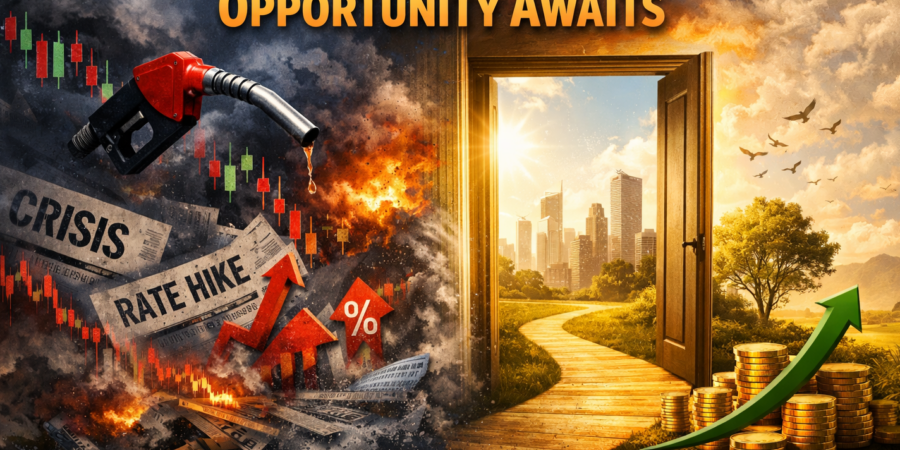
Market Volatility Opportunity. A Noisy Few Weeks, But Opportunity Is Building
Why Market Volatility Creates Opportunity
Recent market volatility is creating opportunity for Australians who stay focused on long-term financial strategy. The Middle East conflict has entered a new and more unsettling phase. After US-Iran peace talks collapsed in Islamabad last weekend, President Trump announced on Sunday that the US Navy would blockade the Strait of Hormuz, one of the world’s most critical shipping channels, through which around a fifth of the world’s oil supply passes each day.
Oil prices, which had briefly pulled back in March on ceasefire hopes, are back above US$100 a barrel. Diesel has surged past $3 a litre again despite the federal government’s fuel excise cut. At the same time, the cost of getting to a GP has quietly become a real issue for many Australians, particularly those outside major cities.
There is a lot going on right now. Jobs, fuel prices, interest rates, the news out of the Middle East. By the time you read this, some of it will have already changed. That is the nature of where we are.
We want to cut through that noise for you, because underneath it there is one thing that stays consistent. Complicated times always carry opportunity alongside the pressure. This is exactly where market volatility opportunity begins to take shape, even when it is hardest to see. Our job is to find it for you, without taking risks with your stability to do it.
Here is what we are seeing this week. Australia’s job market is still holding up. Unemployment stayed at 4.3 per cent in March. That is good news, but the numbers were taken before the fuel price spike really started to bite, so we will know more over the coming months. At the same time, the RBA’s deputy governor has hinted that interest rates are likely to go up again in May. Every sign points that way. It may be the last rise for a while, but we are expecting another one.
Portfolios have taken a trim in recent weeks. That is normal, and it is expected when you are following a disciplined investment strategy. What we would say is that the fall so far is nowhere near what we have seen in past periods of uncertainty. That is a good sign, not a bad one. Share markets also tend to move before the news catches up, often rising before a situation is resolved. In our experience, that is usually a signal worth paying attention to.
What we have been saying to clients this week is simple. If you need cash available, we planned for that, and it is there. If your situation has shifted and you need to adjust, we can structure things so your life stays stable. That is more valuable than riding out a rough patch hoping it passes. It is the reason we build plans the way we do.
Periods like this often feel uncomfortable, but they are where market volatility opportunity tends to emerge. While headlines focus on risk, long-term investors and well-structured financial plans are designed to navigate uncertainty and position for recovery.
If anything in the current environment is prompting questions about your plan, reach out. That is what we are here for.
Why Market Volatility Creates Opportunity
Five things that matter this week
Australia’s unemployment rate stayed at 4.3 per cent in March, with 17,900 new jobs added, according to ABS data released on 16 April. Economists say the survey was conducted before the oil shock hit in earnest, so the real impact on jobs may still be weeks away.
RBA deputy governor Andrew Hauser said this week that stagflation — rising prices alongside slowing growth – is “a central banker’s nightmare.” The RBA meets on 4-5 May. Several major banks and economists, including Capital Economics, are now forecasting another rate rise at that meeting, as inflation is on track to approach 5 per cent by mid-year.
Speaking in New York last week, RBA deputy governor Andrew Hauser made it clear that inflation pressure in Australia is not only about fuel prices. He pointed to broad, domestically-driven price rises that still need to be dealt with, alongside the overseas shock. In plain terms, the RBA sees more work to do, and that reinforces the case for rates going up again in May.
CreditorWatch chief economist Ivan Colhoun warned on 15 April that rising interest rates and fuel costs are pushing insolvency risk higher for Australian businesses. Sole traders and small operators are under the most pressure, as they have less capacity to absorb cost increases than larger businesses
A new analysis from Firstlinks this week highlighted a little-known consequence of the Division 296 tax (the 15 per cent extra tax on super balances above $3 million, which takes effect 1 July 2026). If a super fund member dies before the tax is settled, their estate could end up paying Division 296 tax on unrealised gains — assets that beneficiaries may never actually receive. This applies to defined benefit schemes and some SMSF structures in particular.
If anything in this update has raised a question about your own situation, please do not hesitate to get in touch. That is exactly what we are here for.
This update is general in nature and is not personal advice. For guidance that fits your situation, please speak with your HFI adviser. You may also need specialist legal or tax advice.
If you would like to review your super, investment mix, lending strategy or personal insurance settings in light of these developments, please contact us. We are here to help you plan with confidence.
Ready to review where you stand?
Book an Annual ReviewOpinions in this article are attributable to its author only and do not constitute financial advice. Any advice in this document is general in nature and does not take into account the objectives, financial situation or needs of any particular person. You should obtain financial or legal advice relevant to your circumstances before making investment decisions. Health & Finance Integrated takes no responsibility for, nor gives any endorsement or warranties in relation to any third-party information referred to herein.