
May Inflation Australia: What It Means for Your Money
May inflation Australia data gave households a mixed signal this week. Two significant data releases landed this week. On Wednesday, the May inflation reading came in at 4.0% annually, a step down from the 4.2% recorded in April. On Thursday, the May employment figures showed unemployment easing slightly to 4.4%, with around 40,000 new jobs added to the economy.
Taken together, you might expect a clear narrative to emerge. It has not, and it probably should not. What one month of May inflation Australia data tells us about the direction of interest rates is genuinely limited. The headline consumer price figure improving looks encouraging on its face. But the underlying measure, which strips out volatile items and gives a cleaner read on persistent inflation pressures, moved in the other direction. Housing costs, food, and services continue pushing prices higher in ways that energy price movements alone cannot explain.
The picture is complicated, which is precisely the point. Meaningful patterns in inflation tend to emerge over many months, not from a single release. The Reserve Bank paused at its June meeting, holding the cash rate steady. That pause may indicate something about how close the current tightening cycle is to completing its work. It may also mean the board is waiting for several more months of data before making a further call. Both readings are plausible, and the bank itself has been careful not to foreclose either option.
“Financial markets, operating as a collective forward-looking signal across millions of participants, have consistently told a more optimistic story than sentiment data or news cycles have suggested.”
The comparison to other economies is worth addressing directly. Canada, the United Kingdom, the major European economies, and the United States have all been easing or holding while Australia remains in the later stages of tightening. The reason is not that our central bank got things wrong. Australian inflation has been driven more by domestic factors, particularly services, rents, and the cost of running a household, than by the same energy dynamics that unwound more cleanly elsewhere. Comparing our rate cycle to overseas as if they were the same problem is not particularly illuminating.
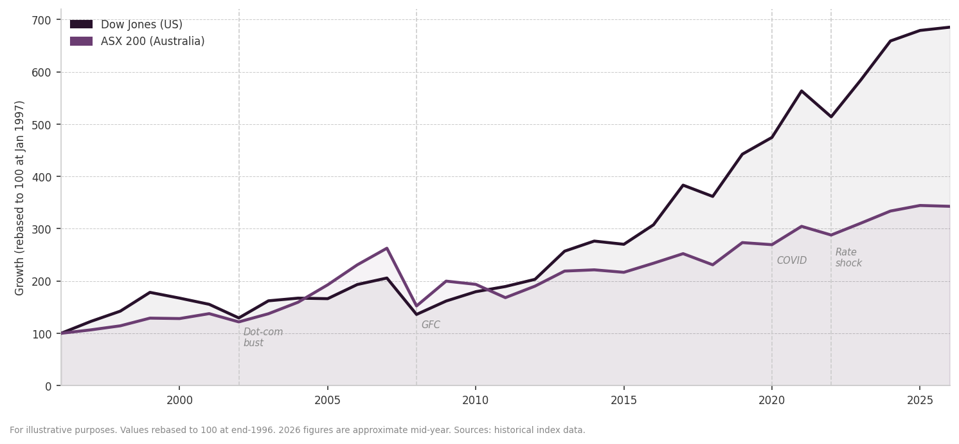
Meanwhile, through all of this, markets have continued to do what they tend to do over time. Through three rate rises, persistent inflation, cost of living pressure, and a wave of competing pessimistic narratives, the Australian sharemarket has closed the 2025 to 2026 financial year near its 12-month highs. Wall Street has held near record levels through most of the period. The volume of alarming commentary has not translated into the market outcomes that commentary implied.
End of financial year is a natural moment to stop and take stock. On the data, the picture is mixed, and that is the honest assessment. On the market signal, the story is more encouraging.
As always, if anything here raises a question about your own situation, we are here. The most useful conversations happen before conditions change, not after.
Five things that matter this week, and why they matter to you
May inflation Australia: the headline fell, the underlying number did not
Annual consumer price inflation eased to 4.0% in May, down from 4.2% in April. On the headline, that looks like progress. But the trimmed mean, which strips out volatile items and gives a cleaner read on persistent inflation pressures, rose from 3.4% to 3.6%. Housing costs are up 6.5% annually, food up 3.3%. The Reserve Bank watches the underlying measure more closely than the headline figure.
Employment held steady in May — another 40,000 jobs added
The unemployment rate edged down from 4.5% to 4.4% in May, with around 40,300 Australians added to the workforce over the month. A resilient labour market alongside sticky underlying inflation gives the Reserve Bank less reason to ease soon. The trend unemployment rate edged marginally higher, reflecting different smoothing of the same data.
Australia is still tightening while others cut — the reason matters
Canada, the United Kingdom, and the eurozone have been easing monetary policy while Australia remains in the later stages of a tightening cycle. This is not because of policy failure. Australian inflation has been more domestic in character, driven by services, rents, and household costs, than the energy-led inflation that has unwound more easily in other markets. Our central bank also took a more measured initial approach than some peers, which shaped a different timeline.
1 July: a suite of changes go live for Australian workers and savers
From 1 July 2026, employers are required to meet their superannuation guarantee obligations on the same payment cycle as wages under the new payday super rules. Division 296 tax, which applies an additional 15% contributions tax to super balances above three million dollars, also commences on the same date. Revised super contribution caps and the income tax adjustments legislated earlier in the year take effect from today as well.
Markets closing the financial year ahead — through everything
Through three rate rises, persistent inflation, Middle East volatility, and a running commentary of economic pessimism, Australian and global markets closed the 2025 to 2026 financial year near their 12-month highs. Wall Street held near record levels through most of the period. The ASX 200 ended the financial year broadly in positive territory. Financial markets, operating as a collective forward-looking signal, have consistently pointed toward an outcome better than the headlines implied.
The common thread: what May inflation Australia data really shows
Each of the five stories above reflects the same underlying tension: conditions are shifting, but the direction is not yet settled. The May inflation Australia figures sit alongside a firmer underlying measure, which is the more important detail for anyone watching interest rates. A resilient jobs market is good news for households but reduces the case for a near-term rate cut. Australia’s slower path compared with other economies reflects a different problem, not a policy misstep. And a new financial year brings genuine change, not just a change of date.
Through it all, markets have continued to price a more settled outcome than the headlines suggest. That does not mean the difficult period is over. It does suggest the market sees a path through.
If anything in this update on May inflation Australia has raised a question about your own situation, please get in touch. That is exactly what we are here for.
Frequently asked questions
Did May inflation Australia data show cooling prices?
What happened to unemployment in May 2026?
Why is Australia still in a tightening cycle while other countries are cutting rates?
What changes take effect from 1 July 2026?
How have share markets performed through the rate cycle?
Ready to review your plan?
Book an Annual Review or a Power Call with your HFI adviser. We are here to help you navigate the year ahead with confidence.
Book an Annual Review Email HFISources
- •ABS Consumer Price Index, Australia, May 2026, released 24 June 2026
- •ABS Labour Force, Australia, May 2026, released 25 June 2026
- •RBA Monetary Policy Board Decision, June 2026 — Reserve Bank of Australia
- •ATO Payday Super and Division 296 tax guidance, ato.gov.au
- •ASX 200 and Wall Street index data, financial year 2025–26
- •HFI: RBA rate pause June 2026: five things that matter this week
- •HFI: CGT and Negative Gearing Changes
Important information
This article is general information only and does not take into account your personal objectives, financial situation or needs. Economic conditions, interest rates, superannuation rules and tax thresholds change over time. You should obtain financial advice from a qualified professional before making any decisions about your superannuation, borrowing, investments or related financial arrangements.
Opinions in this article are attributable to Health & Finance Integrated only and do not constitute financial advice. Any advice in this document is general in nature and does not take into account the objectives, financial situation or needs of any particular person. Health & Finance Integrated takes no responsibility for, nor gives any endorsement or warranties in relation to any third-party information referred to herein.
Health & Finance Integrated is a Corporate Authorised Representative of Able Financial Services, ABN 27 646 319 164, AFSL 530596, Shop 6, 23 Hassall St, Parramatta 2150 NSW.