
Disability Planning for Families
Most conversations about disability planning for families start with a document. A will. A trust deed. An NDIS plan review. These things matter, but they’re not where planning actually begins.
Planning begins with a family. A parent who has coordinated care for twenty years. A sibling who has quietly absorbed more responsibility than anyone has acknowledged out loud. Grandparents who help, until they can’t. A good plan has to work for these people, not just on paper.
The paperwork is only part of disability planning for families
It’s tempting to treat disability planning as a set of tasks: set up a Special Disability Trust, update the will, consider future decision‑making arrangements, tidy up the NDIS plan. Each can be genuinely useful. But the legal and financial structure matters, and it also has to work for the family living with it.
A trust structured well on paper can still struggle in practice if the person expected to manage it doesn’t have the time or capacity to take it on. The documents are only one part. Whether they hold up depends on the people around them.
Future care planning: who will actually be there in five, ten or twenty years?
Underneath most financial questions sits a harder one: who is actually going to provide or coordinate care, and for how long. What happens when that person can no longer do it matters just as much.
Families often have an unspoken assumption about who will take this on, usually a parent, sometimes a sibling. That assumption may hold for years. It may also be untested, or unevenly shared. Bringing it into the open, even briefly, tends to produce plans that hold up better over time.
A future care conversation doesn’t need to happen all at once. Even a short, honest discussion about who is doing what today can surface assumptions worth addressing while there’s still time to plan around them.
Housing, care and money: planning for disability as a whole family
Where someone with disability will live, now and later, is rarely a simple property question. It touches on independence, safety, and proximity to family. It also raises a practical question: what happens if a parent’s home is no longer available as a base? Our article on the family home and aged care explores a related version of this question.
Some families plan around Supported Independent Living. Others plan around a family home being retained, adapted, or eventually sold. Either way, a housing decision made in isolation can have consequences for the financial, care and estate planning around it. These pieces work better when they’re considered together, not signed off one at a time.
Inheritance planning needs more thought than equal shares
For families with a member who has disability, simply dividing an estate equally may not always produce the outcome the family intended. A lump sum left directly to a person receiving Centrelink support may affect their payment under the income and assets tests. It may also be difficult for them to manage directly, depending on their circumstances. Our guide to Centrelink financial planning for carers and families explains how changes to assets and income can affect support payments.
For some families, this is where a Special Disability Trust may be worth considering. An SDT allows assets to be set aside under a specific legislative framework, with the primary purpose of meeting the beneficiary’s reasonable care and accommodation needs. It isn’t the right answer for every family, but it’s worth understanding before decisions are locked in.
Special Disability Trusts have specific rules around contributions, permitted expenses and reporting. Getting the structure right from the outset is far easier than adjusting it once it’s in place.
Why family conversations matter in disability planning
Some of the most carefully constructed plans fail not because they were technically wrong, but because family members found out about them too late, or not at all. A sibling who becomes an executor with no prior conversation about what that involves. A young adult with disability who was never part of a conversation about their own future.
Involving the right people early tends to strengthen a plan rather than complicate it. It doesn’t mean every decision needs to be made by consensus. It simply means the people who’ll eventually live inside the plan understand what it is. For families dealing with illness, disability or overwhelm, our guide to financial advice for vulnerable clients explains why advice may need to be staged and simplified. If a Total and Permanent Disability payout is also part of the picture, our post-TPD advice guide covers what to plan for after approval.
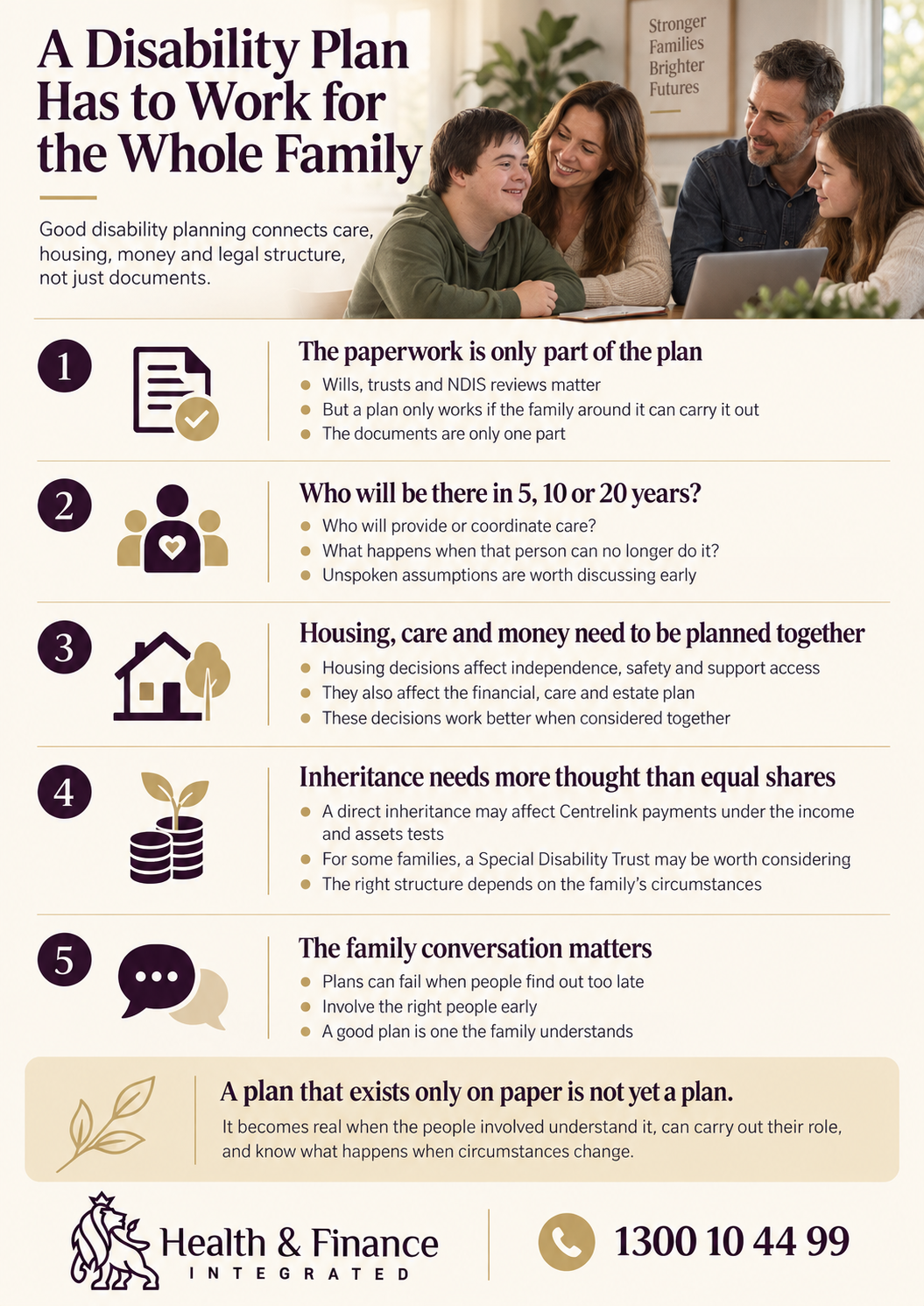
Download this as a quick‑reference guide for your family
“A plan that exists only on paper is not yet a plan. It becomes a real plan when the people involved understand it, can carry out their role, and know what happens when circumstances change.”
Good disability planning connects the documents with the family
Good disability planning for families connects the documents with the people who will actually have to live with them. That means bringing together the care conversation, the housing decision, the estate plan and the family itself, rather than treating each as a separate task to tick off.
None of this needs to happen in one sitting. It usually happens gradually, often alongside a financial adviser, an estate planning lawyer, and sometimes a support coordinator.
Want to talk through your family’s situation?
A short conversation can help bring together the care, housing, estate and financial pieces of your family’s disability planning.
Call 1300 10 44 99Important information
This article is general information only and does not take into account your personal circumstances. Disability planning, Centrelink entitlements, Special Disability Trusts and estate planning arrangements vary significantly depending on individual family situations. You should seek advice from qualified financial, legal and tax professionals before making any decisions. Centrelink rules, means testing arrangements and trust thresholds change over time. Verify current figures with Services Australia before acting. HFI does not provide legal advice or tax agent services unless expressly stated.
Health & Finance Integrated is a Corporate Authorised Representative of Able Financial Services, ABN 27 646 319 164, AFSL 530596, Shop 6, 23 Hassall St, Parramatta 2150 NSW.