
Financial Advice for Vulnerable Clients: Why Simplified Beats Comprehensive
Overview
Financial advice for vulnerable clients often needs to look different from a standard advice process. That includes people managing illness, disability, mental health challenges, cognitive fatigue or emotional overwhelm.
Comprehensive advice assumes people can absorb a full picture: every option, every risk, every “it depends.” For clients in this position, that assumption often doesn’t hold.
These clients generally don’t need more information. They need the decision in front of them simplified, and broken into stages they can work through one at a time. This isn’t a lower standard of advice. It reflects the fact that advice which can’t be understood and acted on isn’t doing its job, however accurate it is.
There’s another layer to this. For some clients, talking about money isn’t just difficult, it can be genuinely distressing. Financial conversations can raise anxiety, bring up past experiences, or feel like one more thing a person doesn’t have the capacity to face. How that conversation is handled can matter as much as what’s said in it.
Why more information isn’t the answer
Being thorough feels like the responsible thing to do. Cover every scenario, explain every option, and the client has what they need to decide.
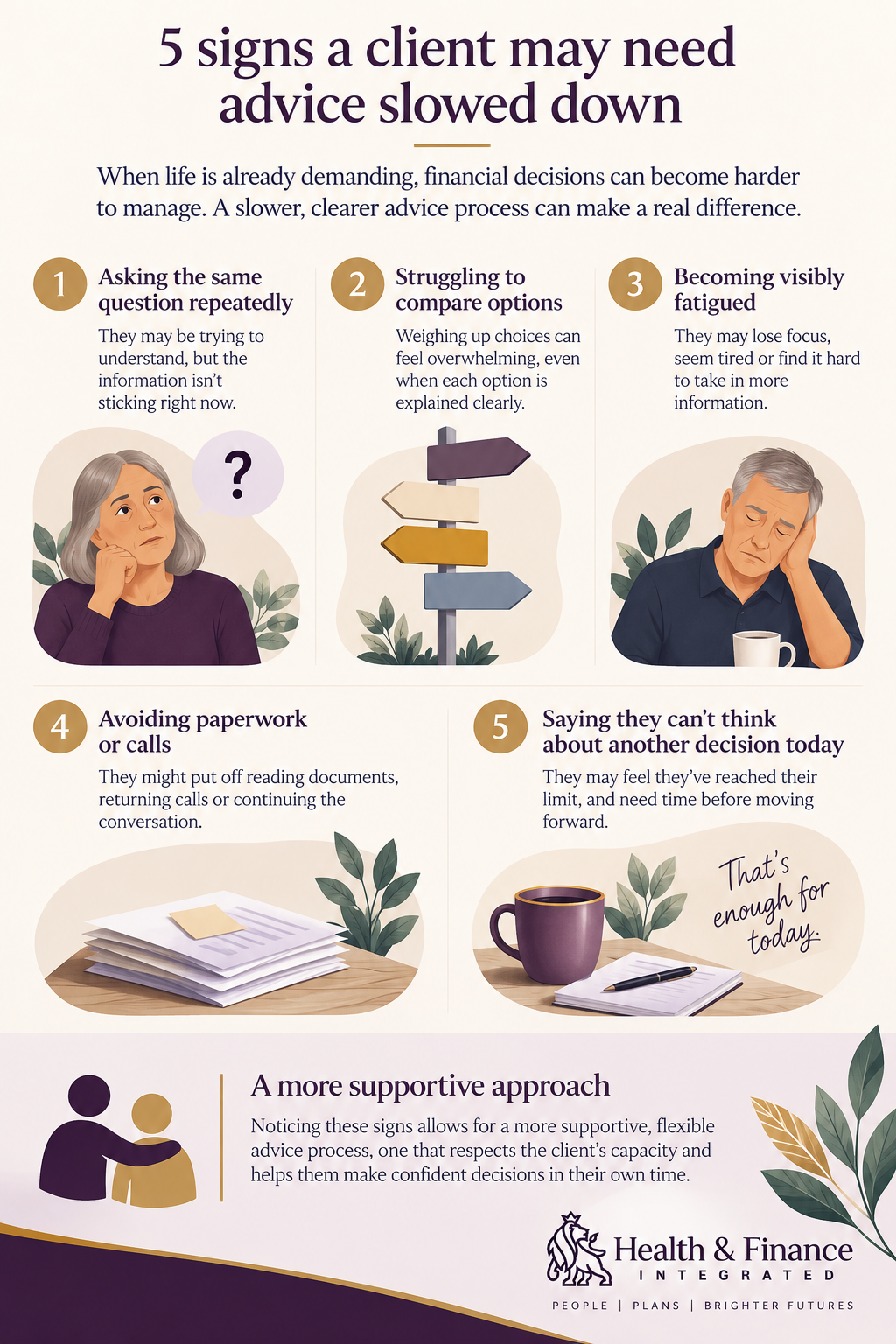
But someone managing a serious illness, a TPD claim, a mental health condition, or a parent’s move into aged care is often carrying more cognitive load than usual, not less. Medication, pain, poor sleep, grief, anxiety and a flood of unfamiliar decisions can all reduce how much a person can take in, even when their judgement is otherwise unaffected.
Handed a comprehensive document in that state, a client may read every word and still not know what to do next. The information was correct. It just wasn’t usable.
When money itself is the trigger
For some clients, the difficulty isn’t only the complexity of the decision. It’s the topic itself. A conversation about superannuation, debt, or a lump sum can bring back memories of financial hardship, family conflict, or the circumstances that led to a claim in the first place. Someone managing a mental health condition may find that a routine financial discussion raises their anxiety well beyond what the actual content warrants.
What financial advice for vulnerable clients can look like in practice
Simplifying isn’t withholding information. Staging isn’t delaying advice. Both mean matching the pace of advice to what someone can actually absorb right now.
In practice, this can look like:
- Identifying the one decision that needs to be made now, and setting the rest aside
- Using plain English first, with technical terms introduced only when needed
- Recommending one clear path rather than several options weighted equally, while still disclosing alternatives
- Checking the client has understood before raising the next decision
- Watching for signs a client has reached their limit for one sitting, and continuing the conversation another day
- Returning to a decision in a later conversation, rather than finalising everything in one meeting
What the client is eventually told generally doesn’t change. How many decisions they’re asked to hold at once does.
A client example
The following is a composite example reflecting common client situations, not a real client.
A client we’ll call Anne received a compensation settlement following a workplace injury that also affected her mental health. In the first meeting, it became clear that a full run-through of her options, Centrelink implications, super and investment structures, would be more than she could take in at once. Anne mentioned that money had been a source of stress in her family long before the injury, and that even opening bills had become difficult.
Rather than one long meeting, her adviser broke the process into shorter sessions. The first covered only the most time-sensitive issue: how to plan around her Centrelink preclusion period. Later sessions dealt with super and investment options once that first decision was settled and she’d had time to adjust. Each session opened with a plain-English recap of what had already been agreed, so Anne didn’t need to hold the whole picture in her head at once.
The advice she ended up with was no different in substance from what a single comprehensive meeting might have produced. What changed was that Anne could actually engage with it, at a pace that matched what she had capacity for at the time.
“Advice which can’t be understood and acted on isn’t doing its job, however accurate it is.”
Staying flexible where the situation is uncertain
Some of the hardest advice situations involve real uncertainty: a health outcome that hasn’t settled, or a housing decision tied to needs that may still change. A single fixed plan can feel more complete than one with open questions, but it can also assume more certainty than actually exists.
A more useful approach builds the recommendation around what’s known now, with clear points to revisit once more is known. This might mean a near-term action that holds up regardless of how things unfold, alongside a note on what to check again and when.
Why this matters for families supporting someone else
Many people working through these decisions aren’t the person directly affected. They’re a spouse, an adult child or a carer, making sense of superannuation and Centrelink rules on someone else’s behalf, often while managing their own exhaustion.
Simplifying and staging can help this group just as much. A carer juggling appointments and paperwork has limited room left for a dense financial document, however well it’s written. One clear next step can be the difference between a family that acts and one that quietly puts the decision off.
If financial stress is affecting your wellbeing or a family member’s, Beyond Blue’s financial wellbeing resources can help. The National Debt Helpline (1800 007 007) offers free, confidential and independent financial counselling that can complement professional financial advice.
The common thread
The technical substance of financial advice doesn’t get simpler because a client is unwell, depleted, or finds the topic itself difficult. Superannuation, Centrelink, aged care fees and disability support stay exactly as complex as they are.
What can change is the delivery: one decision at a time, in plain language, at a pace the client can actually manage, and with room for genuine uncertainty. For clients in this position, that can be more useful than adding another layer of information.
Not sure where to start?
Start with one call.
You don’t need to have everything worked out. Call HFI and we’ll help you identify the most important decision first, then take the rest one step at a time.
Call 1300 10 44 99Important information
This article is general information only and does not take into account your personal circumstances. The client example referenced in this article is a composite illustration and does not describe a real person. Financial, Centrelink and superannuation outcomes vary significantly depending on individual circumstances. You should seek advice from qualified financial, legal, tax and medical or mental health professionals as relevant before making any decisions. If you or someone you know is experiencing financial stress alongside a mental health concern, free independent support is available through Beyond Blue and the National Debt Helpline.
Health & Finance Integrated is a Corporate Authorised Representative of Able Financial Services, ABN 27 646 319 164, AFSL 530596, Shop 6, 23 Hassall St, Parramatta 2150 NSW.