
5 Ways Your Date of Disablement Can Change Your TPD Claim
Overview
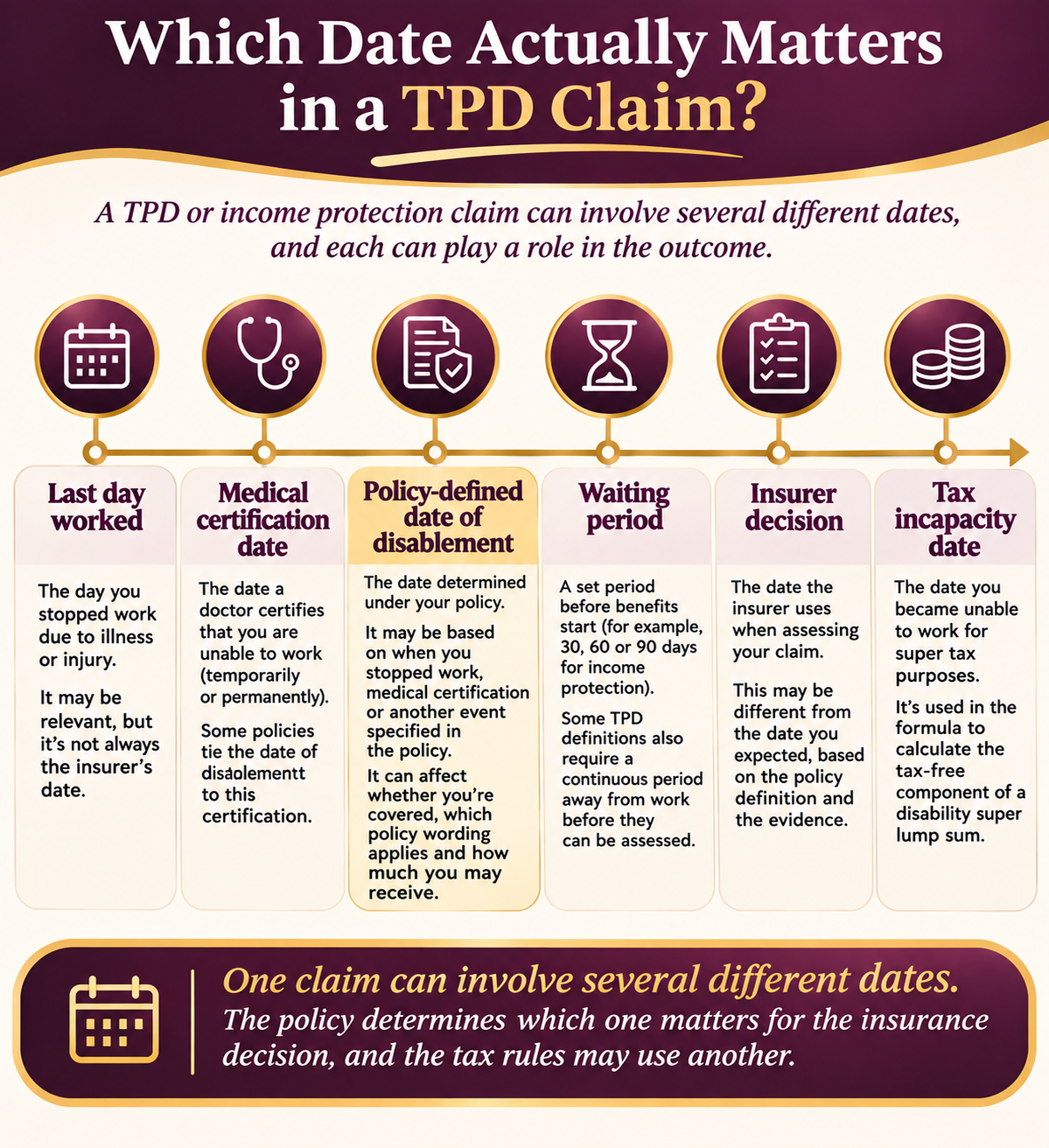
When you make a TPD or income protection claim, the insurer may need to determine a relevant date of disablement or incapacity under the policy. That date can decide whether you are covered, which policy terms apply and how much you may receive. It can also affect how a TPD payout from super is taxed.
The date an insurer uses may not be the day you stopped working or the day your condition became serious. This guide explains why that matters, five ways it can affect your claim and what you can do before and during the process.
What the date of disablement means
For policies that use the term, the date of disablement is the date the insurer treats as the relevant start point for the claim. Each policy defines it in its own way, and some older policies do not define it at all. A common approach is your last day of work due to injury or illness. Other policies may tie the relevant date to a waiting period, medical certification or another event specified in the policy.
Some policies combine these. For example, a policy may use whichever of two dates is later. One is the date you stopped all work, and the other is the date a medical practitioner certifies that you are permanently unable to work again. Under that kind of wording, your date of disablement may fall months after your last day at work.
5 ways the date of disablement can change your claim
Whether your cover was in force
Insurance generally only pays for events that happen while cover is active. If your date of disablement falls after your cover ended, your claim may be declined, even where your condition started earlier.
Cover inside super can stop for reasons people sometimes miss, including changing or closing funds, consolidating accounts, low balances, inactivity or reaching an age limit. For this reason, a cover history for each relevant fund can be important alongside your medical records.
Which policy wording applies
Group insurance in super is renewed and rewritten over time. TPD definitions, exclusions and claim conditions can change from one policy period to the next. The date used for your claim can determine whether an older or newer version of the policy applies.
Limited cover can also be affected. Some members hold cover for new events only, or cover with pre-existing condition exclusions, for a period after joining a fund. If your date of disablement falls within one of those periods, it may affect whether you’re covered for that condition.
Older policy wording can be hard to find. Funds and insurers can usually supply the policy document that applied at a past date, but you may need to ask for it specifically.
How much you receive
Some TPD policies in super use age-based cover, where the sum insured reduces as you get older. In that case, a later date of disablement may mean a lower benefit. For income protection, the monthly benefit is often based on your earnings during a set period before the date of disablement.
If you cut back your hours or took unpaid leave before stopping work, those lower earnings could count when your benefit is calculated. Policies treat this differently, so it is worth reading how pre-disability income is defined in your policy.
When waiting periods start and end
Income protection benefits generally begin after a waiting period, such as 30, 60 or 90 days, measured from the date of disablement. Some TPD definitions require a continuous period away from work before particular parts of the definition can be assessed. The length and effect of that period depend on the policy.
Whether the date can be challenged later
Once a claim has been assessed using a particular policy date, later medical evidence does not necessarily allow that date to be moved backwards. A 2025 Federal Court decision, Australian Retirement Trust v Buckland, shows why.
In that case, a super fund member stopped work in September 2021. Her psychiatrist certified her as permanently unable to work in August 2022. The insurer then paid her TPD benefit based on her cover at that later date. The policy used the later of the date she stopped work and the date of certification. She had also been receiving temporary disablement benefits in the meantime.
AFCA accepted that the policy definition pointed to the August 2022 certification date, but determined that the member should receive the higher benefit associated with the earlier 2021 date. The Federal Court set AFCA’s determination aside. It found that a later medical report could not retrospectively change the certification date under the wording of that particular policy.
A separate date for tax on a TPD payout from super
When a TPD benefit is paid from super as a lump sum, it may qualify as a disability superannuation benefit. For a qualifying disability super lump sum, the tax-free component can be increased using a formula that includes the number of days from when the member became unable to work to their “last retirement day”. That day is generally age 65, although there are exceptions.
All else being equal, an earlier incapacity date can increase the future-service portion of the tax-free component. However, this tax date is not automatically the same as your insurer’s date of disablement or your last day at work. In one private ruling, the ATO did not use the person’s last day at work. Instead, it used the date medical practitioners determined they were unlikely to work again. Private rulings only apply to the person who received them, but the reasoning shows why the dates can differ.
Your super fund calculates the tax components when a qualifying disability super lump sum is paid. Withdrawals, rollovers and staged payments can have different tax consequences, so it’s worth understanding the options before moving the money. Our Post-TPD Advice service covers this in detail.
When the date of disablement is harder to pin down
The date is usually clear when an accident stops you working straight away. It can be much less clear in situations like these:
- Your condition developed gradually and you reduced your hours before stopping.
- You tried to return to work, or moved to lighter duties, after your injury.
- More than one condition is involved, and they started at different times.
- You changed employers or super funds around the time you stopped work.
- Workers compensation payments are ongoing and your employment has not formally ended.
- Your doctors have recorded different views about when you became unable to work.
In these cases, the insurer may choose a date that differs from your own view. Accurate employment and medical records can help you test whether the insurer’s date is right.
What you can do before and during a claim
Start by gathering the evidence that shows your timeline. Useful records include:
- Your last day of work and any changes to your hours or duties beforehand
- Payslips and tax returns covering the period before you stopped work
- Insurance and cover history from each relevant super fund
- The policy wording that applied when you stopped work
- Medical records showing when symptoms began and when doctors first said you could not work
It also helps to talk with your treating doctors about how they describe your capacity and its timing. Their reports may later be read against your policy’s definitions. If you disagree with the date an insurer uses, you can generally ask for a review through the fund or insurer’s internal complaints process. After that, you may be able to lodge a complaint with the Australian Financial Complaints Authority (AFCA). Be aware that time limits may apply.
Getting advice before key dates are locked in
HFI can help you review insurance held across your super funds, understand the financial implications of a TPD or income protection payout, and plan for the effect on your tax, Centrelink payments and longer-term finances.
We don’t provide legal advice, but we can work alongside your lawyer where a claim dispute requires legal input.
If you’ve already received a payout, our post-claim financial strategy guide explains what to consider next.
Lodging a TPD or income protection claim? Talk to us before key dates are locked in.
We can help you understand your insurance cover and the financial implications of a potential payout, including tax and Centrelink.
Call 1300 10 44 99 Read: Post-TPD AdviceRelated reading
- Australian Retirement Trust v Buckland [2025] FCA 1563, Federal Court of Australia
- When you can access your super early, Australian Taxation Office
- Calculating components of a super benefit, Australian Taxation Office
- Insurance in superannuation, Australian Financial Complaints Authority
- HFI: Post‑TPD Financial Advice (After Approval)
- HFI: Post‑Claim Financial Strategy
Important information
This article is general information only and does not take into account your personal circumstances. Insurance policies define the date of disablement in different ways, and the outcome of any claim depends on the policy wording, your medical evidence and the facts of your situation. The tax treatment of a disability superannuation benefit depends on how and when the benefit is paid. You should seek advice from qualified financial, legal and tax professionals before making any decisions. HFI does not provide legal advice or tax agent services unless expressly stated. You should discuss claim disputes with your lawyer and tax consequences with a registered tax professional.
Health & Finance Integrated is a Corporate Authorised Representative of Able Financial Services, ABN 27 646 319 164, AFSL 530596, Shop 6, 23 Hassall St, Parramatta 2150 NSW.