
Do I Need to Declare Compensation When Applying for Disability Benefits?
Overview
If you’re applying for the Disability Support Pension (DSP) while a workers compensation, motor accident or personal injury claim is underway, you might wonder whether you need to declare compensation to Centrelink before you’ve received any money.
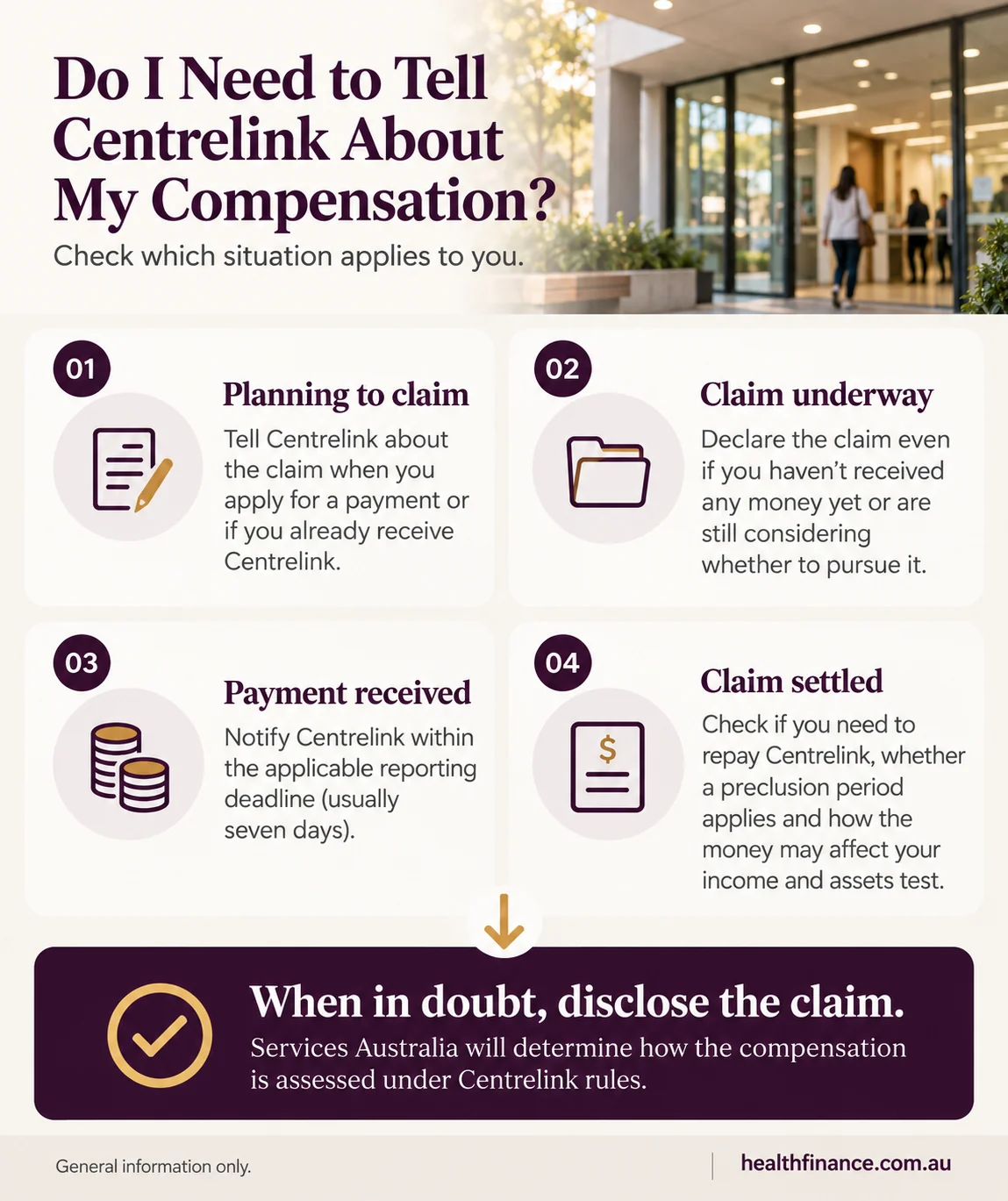
In most cases, yes. You generally need to tell Services Australia about it even if your claim hasn’t settled, or you’re still considering whether to pursue one.
Compensation can affect your Centrelink payments in several ways. You may have to repay money you’ve already received, or go without income support for a period after settlement.
What counts as compensation for Centrelink purposes
For Centrelink purposes, compensation generally means a payment made because of a personal injury, illness or disease. It can be paid as a lump sum or as regular periodic payments. Common examples include:
- Workers compensation payments, including weekly payments and lump sum settlements
- Motor vehicle accident claims, such as CTP or statutory transport schemes
- Public liability and negligence claims, including medical negligence
The part that usually affects Centrelink is compensation for lost earnings or lost capacity to earn. Even if you don’t think the payment will affect Centrelink, it’s better to disclose it and let Services Australia assess it.
What about TPD and income protection? Not every insurance benefit is treated as compensation. TPD benefits and income protection payments through superannuation are generally assessed differently under Centrelink rules. They may still affect your income or assets assessment, depending on how the money is paid and held.
If you’re unsure how your particular payment is classified, check with Services Australia rather than assuming the compensation rules apply.
When you need to declare compensation to Centrelink
What you need to report, and when, depends on whether you’re applying for Centrelink or already receiving payments.
When you apply for a payment
When you claim a payment such as the DSP, JobSeeker or Carer Payment, Services Australia asks about compensation. You need to tell them if:
- a compensation payer has already paid you
- you are currently in the process of claiming
- you plan to make a compensation claim
If you already receive a Centrelink payment
If you or your partner already receive a Centrelink payment, you need to notify Services Australia within seven days after becoming aware that you have received, or will receive, compensation.
If your regular compensation payments change, you must report the change before your next Centrelink payment. This means reporting on your scheduled income reporting day, or within 14 days if you don’t report regularly.
You should also tell Services Australia if compensation stops, and provide the gross payment amount before tax when requested.
How to declare compensation
You can declare compensation to Centrelink in three ways:
- add the details to your online claim for an income support payment
- complete the Compensation and damages form (Mod C)
- call the Centrelink Compensation Recovery line
Services Australia also has an online compensation estimator, which can indicate how compensation may affect your payment. It’s only a guide, and Services Australia advises against using it for lump sums awarded after a contested court or tribunal hearing, or for claims involving only weekly compensation payments. In those cases, contact Centrelink Compensation Recovery directly.
You may also be required to pursue compensation
Under section 1166 of the Social Security Act 1991, Services Australia can require you to take reasonable action to claim compensation you may be entitled to. Reasonable action can include lodging a claim with your employer or the compensation payer, along with supporting medical evidence.
If you do not take reasonable action when required, your claim for a payment may be rejected. Existing payments may also be suspended or cancelled. Payments can resume once the required action has been taken.
There can be valid reasons why someone cannot pursue a compensation claim. For example, the legal time limit may have passed, there may be no enforceable claim, or legal advice may indicate that pursuing compensation isn’t reasonable. If you’re unsure whether you’re expected to pursue a claim, ask Services Australia before withdrawing or abandoning it.
What happens if you don’t declare compensation to Centrelink
A compensation claim can come to Centrelink’s attention even if you haven’t reported it yourself. If it hasn’t been disclosed, you may receive more than you were entitled to, and that overpayment can become a debt you need to repay.
What your lawyer and the insurer may need to do
Your lawyer and insurer may also have obligations to Centrelink during the settlement process. Where Services Australia has issued a Preliminary Notice to a compensation payer, the payer must seek approval before releasing compensation funds.
Centrelink may calculate a compensation charge for income support payments that need to be repaid. That amount can be deducted from the settlement and paid directly to Services Australia before the remaining funds are released.
This process depends on whether a Preliminary Notice has been issued. If money is released without a Centrelink deduction, it does not necessarily mean that no repayment is owed.
Does compensation also need to be reported to the NDIS?
Yes. If you are an NDIS participant or are applying to become one, you also need to tell the National Disability Insurance Agency (NDIA) about relevant compensation claims and payments.
The NDIA has separate rules from Centrelink. Depending on what your compensation covers, it may recover amounts previously paid for NDIS supports related to your injury or apply a compensation reduction amount to your future NDIS funding.
It’s important to notify the NDIA before your claim is finalised. If you wait until after settlement and have already received the money, the NDIA may recover any amount owed directly from you.
Declaring compensation to Centrelink does not replace your obligation to notify the NDIA separately.
Reporting obligations continue after settlement
Not every compensation settlement triggers a preclusion period. The outcome depends on what the payment represents and how the settlement was determined.
Where a lump sum compensation claim is settled and includes an amount for lost earnings or lost earning capacity, Centrelink generally treats 50% of the gross settlement as the compensation component used to calculate a preclusion period. Different rules apply where a court or tribunal determines compensation following a contested hearing.
After settlement, how you hold the money also matters. Bank balances, investments and money held in superannuation may affect Centrelink’s income and assets tests, depending on your age, circumstances and how the funds are held. Changes generally need to be reported within 14 days.
Our guide to the Centrelink preclusion period explains how the period is calculated, and our article on DSP asset limits covers how savings affect the DSP.
How HFI can help
A compensation settlement often comes at the end of a long and difficult process. But it can also bring a new set of financial decisions, particularly if you’re receiving Centrelink payments or can no longer work.
At HFI, we help clients work through the financial consequences of a settlement, including Centrelink recovery, possible preclusion periods and how to manage the remaining funds. We work alongside compensation lawyers so these decisions can be considered in the context of your wider financial circumstances.
If you’re unsure how compensation may affect your Centrelink payments, call Health & Finance Integrated on 1300 10 44 99 to discuss your situation and the next steps.
Related articles and advice
Explore the financial questions that often arise alongside this topic:
Approaching settlement? Talk to us before key decisions are made.
HFI works with clients before and after settlement, alongside their compensation lawyer.
Call 1300 10 44 99 Read: Preclusion Period GuideRelated reading
- Tell us about compensation, Services Australia
- How compensation affects payments, Services Australia
- Social Security Guide 3.1.9.20: Requirements to pursue and obtain compensation
- Social Security Guide 4.13.2.30: Compensation part of lump sum, 50% rule
- What is compensation?, NDIS
- HFI: Centrelink Preclusion Period: What It Means for Your Financial Future
- HFI: How Much Money Can I Have in the Bank and Still Get Disability Support?
Important information
This article provides general information only and does not take into account your personal objectives, financial situation or needs. Compensation recovery, preclusion periods, income and assets assessments, and reporting obligations depend on the type of payment, the circumstances of the claim and the applicable rules. Seek advice from Services Australia and appropriate legal, financial or tax professionals before making decisions. Health & Finance Integrated does not provide legal advice.
Health & Finance Integrated is a Corporate Authorised Representative of Able Financial Services, ABN 27 646 319 164, AFSL 530596, Shop 6, 23 Hassall St, Parramatta 2150 NSW.