Advisory Update: Rate Rises, Record Petrol & CGT Reform
HFI Advisory Update · 30 March 2026
Petrol prices are at record highs. Interest rates have risen twice this year already. The share market has had a difficult month. And with a Federal Budget on 12 May, there is no shortage of noise about what might change next. If you have been searching for financial advice on Australia’s interest rate environment, the ASX falls, and potential CGT reform, you are not alone.
The honest answer is that several things are happening at once. Here is what is actually going on — and what it means for your position.
The Macro Picture
A conflict in the Middle East has disrupted global oil flows through the Strait of Hormuz, the narrow waterway that carries roughly a fifth of the world’s seaborne energy. That disruption has pushed petrol prices well above $2.00 a litre, with some regional areas seeing prices close to $2.50. It has also added fresh pressure to inflation globally, at a time when Australia’s Reserve Bank was already working to bring prices under control.
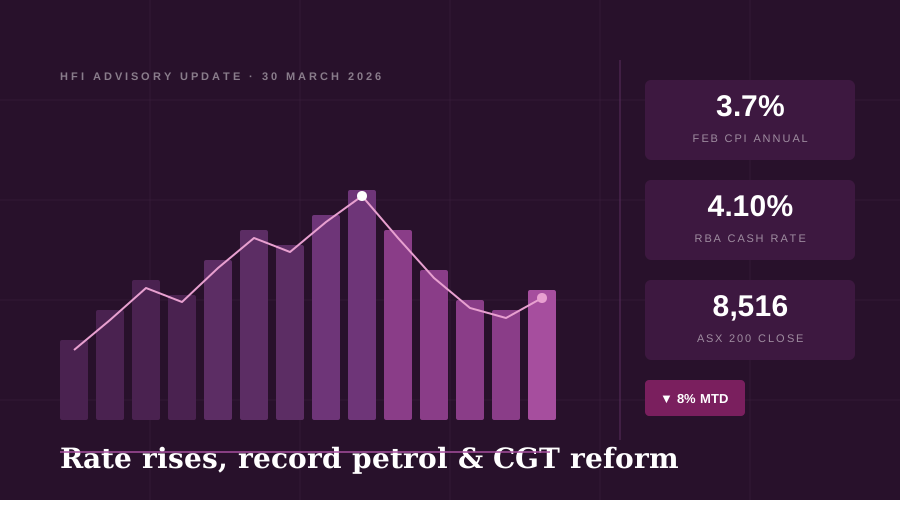
The RBA lifted the cash rate twice in quick succession this year, from 3.6% to 4.10%. Markets and the major banks are now pricing in a third rise in May. For people with mortgages, this is real pressure. For retirees and those drawing down savings, the picture is more nuanced — cash and fixed income investments are now paying meaningfully more than they were two years ago.
The ASX 200 has had a difficult month, down around 8% from its February high of 9,202. That said, the final week of March produced the first weekly gain in four. The index remains around 8% higher than it was twelve months ago. Sharp short-term falls are uncomfortable to watch, but they are a normal feature of share markets during geopolitical shocks.
Five Things That Matter This Week
1 February CPI came in at 3.7% — slightly below expectations
The ABS released the monthly Consumer Price Index for February 2026 on 26 March, showing annual inflation of 3.7%, down marginally from 3.8% in January. The RBA’s preferred measure, trimmed mean inflation, held steady at 3.3%. Housing costs remained the largest driver, up 7.2%, largely due to electricity prices rising 37% as government rebates unwound. Economists cautioned that March data will look quite different once the fuel price surge flows through.
2 Petrol prices hit record highs, with a national supply response under way
National average unleaded petrol reached around $2.20 per litre in the week ending 30 March, up from approximately $1.57 before the Middle East conflict escalated in late February. Regional areas have seen higher prices still, with some reports of $2.50 per litre. The government has drawn on emergency fuel stockpiles, eased fuel standards temporarily, and introduced new powers to support private importers. Treasurer Chalmers ruled out cutting the fuel excise, currently 52.6 cents per litre, citing concerns about stimulating demand during a supply disruption.
3 ASX 200 records first weekly gain in four weeks — but remains 8% below its February high
The ASX 200 finished the week ending 28 March up approximately 1%, closing around 8,516 — its first positive week since early March. The index had shed roughly $250 billion in market value over the prior three weeks, driven by geopolitical risk, higher energy prices, and the back-to-back RBA rate rises. The modest recovery reflected bargain hunting and a brief improvement in ceasefire sentiment, though the index remains well below its all-time high of 9,202 reached in February 2026.
4 Division 296 super tax passed parliament — takes effect 1 July 2026
The Treasury Laws Amendment (Building a Stronger and Fairer Super System) Bill 2026 passed the Senate on 10 March 2026 without further amendment. From 1 July 2026, individuals with total superannuation balances above $3 million will pay an additional 15% tax on earnings attributable to the amount above that threshold, bringing the effective tax rate to 30%. Critically, the final legislation taxes only realised earnings, not unrealised gains as originally proposed. The first ATO assessments will be issued after 30 June 2027.
5 CGT discount reform: no decision yet, but the May Budget is the moment
The Senate Committee inquiry into the capital gains tax discount (reported 17 March) found that the current 50% discount disproportionately benefits wealthier investors and has contributed to housing unaffordability. Treasury is reportedly modelling a reduction from 50% to 33% for residential investment property, while retaining the 50% discount for shares and other assets. Grandfathering — which would protect properties purchased before any change takes effect — is considered highly likely based on expert testimony. The Federal Budget is scheduled for 12 May 2026.
Our approach to financial advice in Australia
In the middle of all this, it helps to remember what a well-constructed financial plan is designed to do. It is built to absorb shocks like these, not to avoid them. Diversification, appropriate asset allocation, and a long-term time horizon exist precisely because events like energy shocks, rate rises, and tax changes are not rare — they are part of the landscape.
Sound financial advice is not built around predicting what markets will do next month. It is built around identifying what you need your money to do over the next decade, and constructing a plan that can survive uncertainty — including Australia’s current interest rate rise cycle.
If the current environment has raised questions for you, that is a reasonable response. It does not necessarily mean action is required — but it does mean a conversation with your adviser is worth having. We are here for that.
Ready to review your position?
If anything in this update has raised a question about your own situation, we are here to help you plan with confidence.
Opinions in this article are attributable to its author only and do not constitute financial advice. Any advice in this document is general in nature and does not take into account the objectives, financial situation or needs of any particular person. You should obtain financial or legal advice relevant to your circumstances before making investment decisions. Health & Finance Integrated takes no responsibility for, nor gives any endorsement or warranties in relation to any third-party information referred to herein.
Health & Finance Integrated is a Corporate Authorised Representative of Able Financial Services (ABN 27 646 319 164) AFSL 530596, Shop 6, 23 Hassall St, Parramatta 2150 NSW.