Another rate rise is likely in May. Here is what the next 90 days could look like for your finances.
HFI Advisory Update · 07 April 2026
If you have been searching for financial advice on Australia’s interest rate outlook, you are not alone.
The Macro Picture
A lot has happened in a short time. Two interest rate rises since February, a sharp jump in petrol prices, and a Federal Budget now only five weeks away. This update covers what it means for your household and what to watch in the weeks ahead.
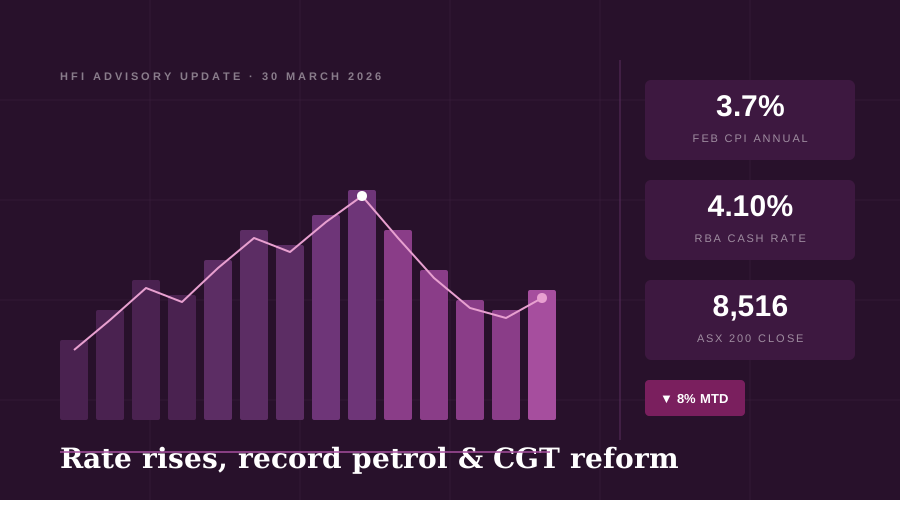
The big news this week: all four major banks are now expecting the Reserve Bank to raise interest rates again on 6 May. That would take the cash rate from 4.10% to 4.35%, the third rise in three months. ANZ was the last of the four to change its view, doing so this week. Westpac is going further, saying rates could climb as high as 4.85% later in the year if the conflict in the Middle East keeps pushing up fuel and other prices.
The key piece of information before the May decision is the March inflation figures, due in late April. These will be the first official numbers to show how much the March petrol price spike has flowed through to the cost of living. If they come in high, another rate rise is almost certain. If they come in lower than expected, there is a small chance the Reserve Bank holds off.
On the positive side, the government halved the fuel excise on 1 April, saving about 26 cents per litre at the pump. Petrol prices have come down from their record high of $2.38 per litre in late March, though they remain well above where they were before the conflict began. The relief is real, but it is not a permanent fix, prices are expected to stay elevated through mid-year.
There is also a confirmed tax cut coming on 1 July. If you earn between $18,201 and $45,000, your tax rate will drop slightly, saving up to $536 per year. This is already law and does not depend on the May Budget.
Share markets have been jumpy but have held up reasonably well over the past year, up around 8.6% in the twelve months to Easter. Ups and downs during uncertain times are normal. The best approach is to keep your plan in place and call us if something in this update makes you want to talk through your own situation.
Five Things That Matter This Week
1 All four major banks are now forecasting another RBA rate rise in May
Following the RBA’s narrow 5 to 4 vote to lift the cash rate to 4.10% in March, ANZ this week dropped its hold position, meaning all four big banks now agree: another 25-basis-point rise on 6 May to 4.35% is the base case. Westpac has taken a harder line, forecasting rates could reach 4.85% by August if the energy shock proves persistent and inflation trends toward the mid-fives by June.
2 Government halves fuel excise from 1 April, cutting prices at the pump
The government cut the fuel excise from approximately 52.6 cents to 26.3 cents per litre effective 1 April 2026. Average unleaded petrol prices, which had hit a record $2.38 per litre in late March, fell to around $2.23 to $2.44 across capital cities in early April. Treasury modelling estimates a sustained oil price above $120 per barrel could shave 0.6% or more from GDP, but the excise cut provides partial and immediate relief to households and small businesses.
3 ASX closes Easter week around 8,579 as oil spike weighs on markets
The ASX ended its shortened Easter trading week at 8,579, down 1.06% on Thursday after Donald Trump announced plans for further US military action in Iran, sending oil above $107 per barrel and triggering broad selling across risk assets. Mining giants BHP, Rio Tinto and Fortescue each fell between 2.5% and 4%, while the financial sector held relatively firm. Over the full week, the ASX recorded a modest 0.7% gain, lifted by strong commodity prices earlier in the period. The index is up around 8.6% over the past twelve months.
4 Income tax cut arriving on 1 July 2026, up to $536 per year
Already legislated and taking effect in three months: the marginal income tax rate for earnings between $18,201 and $45,000 drops from 16% to 15% from 1 July 2026, delivering up to $536 per year in savings for workers in that bracket. A further cut to 14% follows from July 2027. These reductions were legislated in the 2025 Budget and are completely separate from anything that may be announced in the 12 May Federal Budget.
5 March CPI data due late April, the single most important number before the May rate decision
The March quarter CPI, expected in the final week of April, will be the first official measure to capture the full impact of the March fuel price surge. Westpac’s economists estimate March CPI could rise by around 1.0% in a single month, which, if confirmed, would push headline inflation toward 5.5% year-on-year by mid-2026, well above the RBA’s 2 to 3% target. Commonwealth Bank’s central scenario places headline inflation at 5.4% by mid-year. This one number will either confirm a May hike or give the Board a reason to pause.
Our approach to financial advice in Australia
In the middle of all this, it helps to remember what a well-constructed financial plan is designed to do. It is built to absorb shocks like these, not to avoid them. Diversification, appropriate asset allocation, and a long-term time horizon exist precisely because events like energy shocks, rate rises, and tax changes are not rare. They are part of the landscape.
Sound financial advice is not built around predicting what markets will do next month. It is built around identifying what you need your money to do over the next decade, and constructing a plan that can survive uncertainty, including Australia’s current interest rate rise cycle. If your retirement income strategy or investment portfolio has not been reviewed recently, now is a good time.
If the current environment has raised questions for you, that is a reasonable response. It does not necessarily mean action is required, but it does mean a conversation with your adviser is worth having. We are here for that.
Opinions in this article are attributable to its author only and do not constitute financial advice. Any advice in this document is general in nature and does not take into account the objectives, financial situation or needs of any particular person. You should obtain financial or legal advice relevant to your circumstances before making investment decisions.