
How Does Income Protection Insurance Work in Australia?
Overview
If illness or injury means you can’t work, income protection insurance can help replace part of your earnings. But how much you receive, and for how long, depends on the policy you hold.
Sometimes called salary continuance insurance, or long-term disability insurance overseas, income protection may already be included in your superannuation without you realising it.
Some policies pay benefits for only two years. Others may continue until a specified age, provided you keep meeting the policy’s conditions. Policies also differ in how they assess your income, your ability to work and other payments you receive.
This guide explains what to look for in your cover and how income protection can interact with TPD, superannuation, tax and Centrelink.
How income protection insurance works in Australia
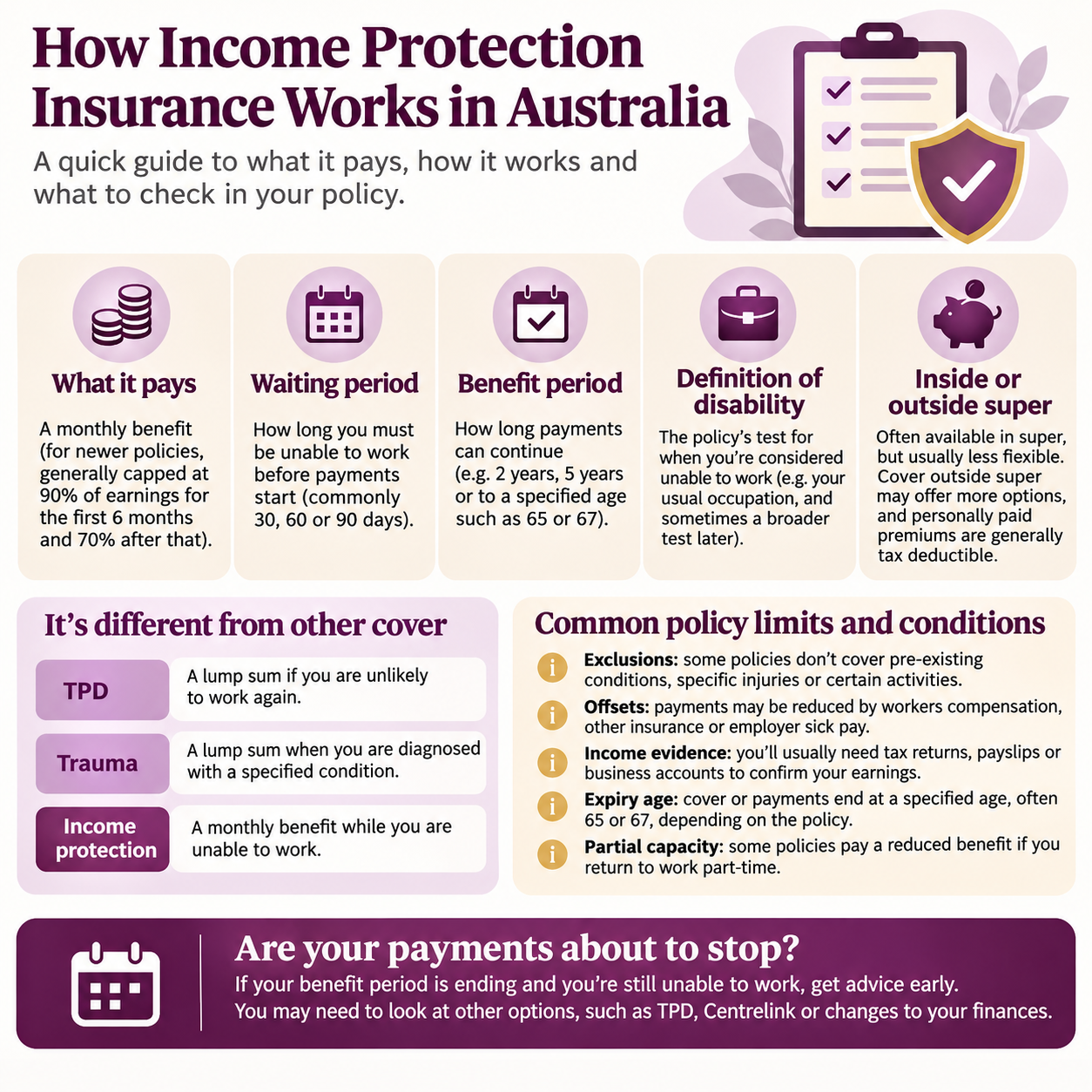
Income protection is different from TPD and trauma insurance. TPD pays a lump sum if you are unlikely to work again, and trauma cover pays a lump sum when you are diagnosed with a specified condition. Income protection pays a monthly benefit while you are unable to work.
The monthly benefit
For new individual income protection policies issued from October 2021, APRA’s framework generally limits total insured benefits to 90% of earnings for the first six months of a claim and 70% after that. These are maximum limits, not guaranteed payment rates. Your actual benefit depends on the policy and the income assessment at claim time.
For newer policies, the insurer generally looks at earnings around the time you became unable to work. For people with relatively stable income, this commonly means the previous 12 months. Different averaging arrangements may apply to people with variable earnings, such as some self-employed workers.
The waiting period
The waiting period is how long you must be unable to work before benefits start. Common options include 30, 60 or 90 days. A longer waiting period usually means a lower premium, so you may need savings or leave to cover the gap. Benefits are also generally paid monthly in arrears. Moneysmart’s income protection guide explains these options in more detail.
The benefit period
The benefit period is how long payments can continue while you remain unable to work. Typical options include two years, five years, or up to a specified age such as 65 or 67. Many default policies in super have shorter benefit periods than people expect.
The definition of disability
Every income protection policy has its own definition of disability. Some policies initially assess whether you can perform your usual occupation, then apply a broader test later in the claim. This may involve looking at whether you can work in another occupation suited to your education, training and experience.
Not all policies work this way. The definitions, timing and conditions are set out in the policy wording and can make a significant difference to whether payments continue.
Read the definition of disability in your policy carefully. If it changes during a claim, ask your insurer or adviser when and how.
Income protection insurance inside or outside super
Many super funds offer income protection as default or optional cover. Premiums come out of your super balance, which can ease pressure on your day-to-day cashflow. Over time, however, those deductions reduce your retirement savings, and the cover is usually less flexible. Default cover in super is often the only income protection insurance people hold, so it’s worth checking what it actually pays.
Cover held outside super is generally more tailored. You may be able to choose a longer benefit period, extra features or a broader definition of disability. Premiums you pay personally for income protection can generally be tax deductible, while premiums paid through super are not deductible to you.
Income protection benefits are generally assessable income. However, payments made through super can involve additional superannuation tax and release rules. Your fund can usually only pay the benefit once you meet a condition of release, such as temporary incapacity.
What your policy may not cover
Income protection insurance replaces part of your income, but it has limits. It’s worth knowing what the policy won’t pay for, as well as what it covers.
- Exclusions. Some policies exclude pre‑existing conditions, specific injuries or certain activities noted when the cover was taken out.
- Offsets. Many policies reduce your benefit by other disability‑related income, such as workers compensation, other insurance or employer sick pay.
- Income evidence. You generally need tax returns, payslips or business accounts to support a claim, which can be harder with irregular income.
- Expiry age. Cover usually ends at a set age, regardless of your health at that time.
- Partial capacity. Some policies pay a reduced benefit if you return to work part‑time, but the calculation varies between insurers.
What if your income protection payments are about to stop?
Some people receive income protection payments for months or years before discovering that their policy is approaching the end of its benefit period.
If you’re still unable to work, it’s worth checking whether you have TPD cover, whether you may qualify for Centrelink income support and what happens to your superannuation and other insurance arrangements.
Don’t assume a TPD payment will automatically replace your income protection benefits, or that Centrelink payments will begin as soon as your insurance stops. Each has its own eligibility and assessment rules.
You may be able to claim both income protection and TPD, depending on your policy terms. Some TPD policies require you to have been off work for a specified period before the insurer can assess your claim. Under some policies, a TPD payment can also affect an income protection claim. HFI’s Post-TPD Advice service covers planning once a TPD claim is approved.
How income protection insurance affects Centrelink
Income protection payments can affect Centrelink entitlements, including JobSeeker and the Disability Support Pension. However, the rules depend on where the insurance is held and how the benefit is paid.
Regular income protection benefits paid through a superannuation fund are generally assessed as ordinary income. Payments from policies held outside super may be treated as compensation or ordinary income, depending on the policy, who contributed to it and whether Centrelink payments are offset against the insurance benefit.
Where payments are treated as compensation, different recovery rules may apply. A lump sum settlement can also have Centrelink consequences, but it does not automatically create a preclusion period. Our Centrelink preclusion period guide explains how preclusion periods work.
If you receive both Centrelink and income protection, it’s important to have the payments correctly classified before relying on the amount of income you’ll receive.
Report income protection payments to Services Australia so they can assess them correctly. Keep copies of your insurer’s payment statements in case you need them later.
Seven questions to ask about your cover
- What is my waiting period, and how will I cover expenses until the first payment?
- How long is my benefit period, and when does it end?
- Does the definition of disability change during my claim, and if so, when?
- What income will the insurer use to calculate my benefit?
- Which other payments will be offset against my benefit?
- Is my cover in super still active, and at what age does it end?
- Do I also hold TPD or trauma cover, and how do the claims interact?
How HFI can help
Income protection and TPD insurance can provide financial support when illness or injury prevents you from working. But the payments don’t always work together as people expect, particularly when superannuation, tax and Centrelink are involved.
HFI helps clients understand the financial implications of their insurance benefits, plan around changes to income and consider the decisions that follow a claim. You can read about our advice process to see what happens at each stage.
Unsure what happens when your income protection ends?
Call 1300 10 44 99 to discuss your situation and whether further financial advice may be appropriate.
Call 1300 10 44 99 Read about post-TPD financial adviceRelated reading
- Income protection insurance, Moneysmart (ASIC)
- Final individual disability income insurance sustainability measures, APRA
- Guide to Social Security Law 4.3.9.30: Income from personal injury insurance schemes, DSS
- Income protection insurance deductions, Australian Taxation Office
- HFI: Our Advice Process
- HFI: Centrelink Preclusion Period: What It Means for Your Financial Future
- HFI: Post-TPD Financial Advice (After Approval)
Important information
This article is general information only and does not take into account your personal circumstances. Income protection, TPD and other insurance benefits depend on the terms of the individual policy, including definitions, waiting periods, benefit periods, offsets and exclusions. Centrelink, tax and superannuation outcomes vary depending on your situation and how payments are made. You should read your policy wording and seek advice from qualified financial, legal and tax professionals before making any decisions. Rules and thresholds change over time, so verify current information with your insurer, super fund, Services Australia or the ATO before acting. HFI does not provide legal advice, insurance claims management or tax agent services unless expressly stated.
Health & Finance Integrated is a Corporate Authorised Representative of Able Financial Services, ABN 27 646 319 164, AFSL 530596, Shop 6, 23 Hassall St, Parramatta 2150 NSW.