
How Is a TPD Payout From Super Taxed?
Overview
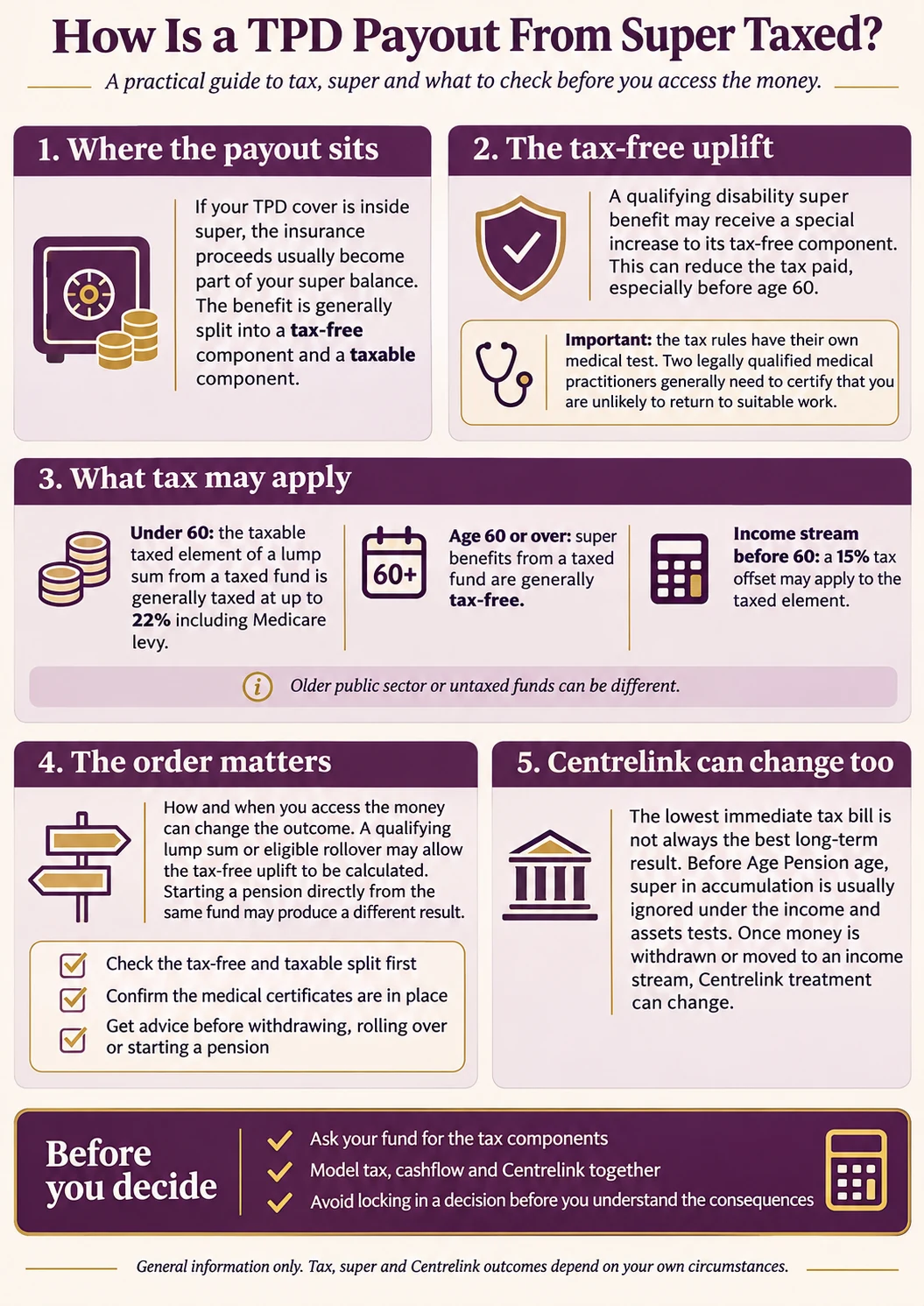
Once a TPD claim is approved, the next question is often how much of the money you will actually keep. TPD payout tax depends on where the insurance was held, your age when the money is paid, and whether you take it as a lump sum or an income stream. For people under 60, a special rule known as the tax-free uplift may increase the tax-free portion of a qualifying TPD benefit paid from super. How much it changes the tax depends on your personal circumstances and the way the benefit is paid.
This guide explains how tax on a TPD payout from super generally works in Australia. It also covers what can change the final figure, and the decisions worth thinking through before any money leaves your fund.
Why TPD inside super is taxed differently
Where your TPD cover is held makes a real difference. A TPD benefit from a policy you own personally, outside super, is generally paid as a tax-free lump sum. Retail policies held in your own name often fall into this group.
TPD cover held through a super fund works differently. The insurer pays the benefit into your super account first, so it becomes part of your super balance. When it is later withdrawn or rolled over, super tax rules apply.
Your super balance is generally made up of a tax-free component and a taxable component. Insurance proceeds paid into super usually form part of the taxable component. However, a special adjustment can apply when the benefit is paid because of permanent disability.
How the tax-free uplift reduces TPD payout tax
When super is paid out because of permanent disability, the law can increase the tax-free part of the payment. This applies to a disability superannuation benefit under section 307-145 of the Income Tax Assessment Act 1997. To qualify, two legally qualified medical practitioners generally need to certify that, because of ill health, you are unlikely to ever work again in a job you are reasonably qualified for by education, training or experience. Your fund may already hold these certificates from the TPD claim.
The extra tax-free amount is worked out with this formula:
This formula gives the additional tax-free amount only. Any ordinary tax-free component already in your super is added to it separately.
Days to retirement are counted from the day you stopped being capable of gainful employment to your last retirement day, generally your 65th birthday. Service days are the days in the service period for the payment, which usually starts from your eligible service date in the fund.
In practical terms, a younger person with a shorter service period tends to receive a larger uplift. The uplift also applies to the whole benefit paid, including your existing super balance, not only the insurance proceeds. For a personal estimate, HFI’s TPD Tax Calculator shows how the uplift may apply to you.
How the taxable component is taxed if you are under 60
Once the total tax-free component has been calculated, including any uplift, the remaining amount is the taxable component. If you are under 60 and withdraw it as a lump sum, the taxed element is generally subject to a maximum effective rate of 22% including the Medicare levy, or your marginal tax rate if that is lower. Your fund withholds tax when it pays you, and the final amount is worked out in your tax return.
Once you turn 60, lump sums from a taxed super fund are generally tax-free. For someone close to 60, the timing of a withdrawal can therefore change the result significantly. Some public sector and older schemes also hold an untaxed element, and different rates apply to that money.
The taxable component is also reported in your tax return for the year. As a result, a large lump sum may affect other income-tested items for that year. A registered tax agent can check how it fits with the rest of your return.
Before you withdraw anything, ask your fund for a breakdown of the tax-free and taxable components it expects to apply, including any uplift. It is much easier to query a figure before the payment is made than after.
Lump sum or income stream: how the choice changes the tax
You do not have to take the whole benefit as cash. Many people leave some or all of it in super, or use it to start an income stream such as an account-based pension.
If you are under 60 and receive a disability super income stream, the taxable portion of each payment is generally taxed at your marginal rate, less a 15% tax offset. The tax-free portion is not taxed. From age 60, payments from a taxed fund are generally tax-free. Money left in accumulation phase is taxed differently again, with fund earnings generally taxed at up to 15%.
The order of transactions matters. The tax-free uplift can apply when a qualifying disability superannuation benefit is paid as a lump sum, including an eligible rollover to another super fund. Where a rollover qualifies, the transferring fund should calculate the uplift and report the revised tax components.
Starting an income stream directly from the same super interest may not produce the same outcome. Before withdrawing, rolling over or starting a pension, ask your fund and adviser how the tax-free component will be calculated and whether the required medical certification is in place.
What can shrink or grow the uplift
Two people with the same TPD benefit can end up with very different tax on their TPD payout. Several factors can influence the result:
- Your eligible service date. A rollover from an older fund can carry an earlier service date into your account. This lengthens the service period and may reduce the uplift, even where the rollover happened years ago or through automatic consolidation.
- How your service dates are recorded. The tax‑free uplift uses dates defined by law, but your fund’s records may affect the calculation. If you’ve transferred super between funds or have an unusual employment history, it’s worth checking which dates the trustee is using.
- When you withdraw. A payment made shortly before or after your 60th birthday can be taxed very differently.
Once a lump sum has been paid, its tax components are fixed for that payment. Any review of service dates, rollovers or timing therefore needs to happen beforehand.
How a TPD payout can affect Centrelink
Tax on your TPD payout is only part of the picture. If you receive the Disability Support Pension, or may claim it later, where your TPD money sits also matters.
For people under Age Pension age, super held in accumulation phase is generally not counted under the Centrelink income and assets tests. Once money is withdrawn, its Centrelink treatment depends on what you do with it. Money held in a bank account or invested will generally be assessed under the income and assets tests, while other uses may be treated differently. A super income stream is also generally assessed.
The option that produces the lowest immediate tax bill may not produce the best result once Centrelink payments and future income needs are considered. Our guide to DSP asset limits explains how savings and investments are assessed.
Questions to ask before you withdraw
Before any money leaves your fund, it can help to work through a few questions with your adviser:
- What is my eligible service date, and has a past rollover changed it?
- Will my fund apply the uplift to a lump sum, a rollover, or both?
- How close am I to 60, and would waiting change the tax I pay?
- How much cash do I actually need now, and could the rest stay in super?
- How would each option affect my Disability Support Pension, or my partner’s payments?
- Does my will, super nomination or power of attorney need updating? Our article on reviewing your estate plan after a payout covers what to check.
The answers often point in different directions. HFI’s Post-TPD Advice service compares these options side by side, covering tax, Centrelink and long-term income, before a final decision is made.
TPD payout tax at a glance
TPD claim approved? Talk to us before the money leaves super.
The way a TPD benefit is paid can change how much you keep, sometimes by a large amount. HFI helps clients compare lump sum, rollover and income stream options before anything is locked in. Prefer to talk first? Call 1300 10 44 99.
Book an Appointment Try the TPD Tax CalculatorRelated reading
- Tax on super benefits (early access), Australian Taxation Office
- Payments from super: key rates and thresholds, Australian Taxation Office
- Income Tax Assessment Act 1997 (Cth), section 307‑145, Federal Register of Legislation
- HFI: TPD Tax Calculator
- HFI: Post‑TPD Financial Advice (After Approval)
- HFI: How Much Money Can I Have in the Bank and Still Get Disability Support?
- HFI: How Does Income Protection Insurance Work in Australia?
Important information
This article is general information only and does not take into account your personal circumstances. The tax treatment of a TPD benefit depends on your age, the components of your super balance, your fund’s service dates and how the benefit is paid. Tax rates, caps and Centrelink rules change over time, so check current figures with the ATO and Services Australia before acting. HFI does not provide tax agent services unless expressly stated. You should seek advice on tax consequences from a registered tax professional before making any decisions.
Health & Finance Integrated is a Corporate Authorised Representative of Able Financial Services, ABN 27 646 319 164, AFSL 530596, Shop 6, 23 Hassall St, Parramatta 2150 NSW.