
What Insurers Look For When You Make a TPD Claim
Overview
If you can no longer work because of illness or injury, you may be able to claim a Total and Permanent Disability (TPD) benefit through your super fund or a separate insurance policy. Whether you get paid depends on the TPD assessment, which is the insurer’s process for deciding whether you meet the policy’s definition of disability. That definition is often narrower than people expect, and it may differ from how your doctor, Centrelink or a workers compensation insurer sees your condition.
This guide explains how insurers define disability, what happens during a TPD assessment, and what you can do to keep your claim on track.
What “disabled” means to an insurer
An insurer doesn’t assess whether you are disabled in a general sense. It assesses whether you meet the definition in the policy terms that applied at the relevant date for your claim. A serious diagnosis on its own usually won’t decide the claim. The insurer is looking at how your condition affects your capacity to work, now and into the future.
Each system you deal with also applies its own test. Services Australia uses the Impairment Tables for the Disability Support Pension. Workers compensation schemes have their own rules about incapacity, and a TPD insurer follows the policy wording. Because of this, approval in one system won’t guarantee approval in another.
The relevant date for your claim depends on the policy and your circumstances, so the insurer will want to know when you stopped work and why. If your cover was cancelled or reduced before that date, it may affect what you can claim.
Common TPD definitions of disability
Policies use several types of definition. Your policy may contain more than one, and the one that applies can depend on whether you were working when you became disabled.
- Any occupation: You are unlikely ever to work again in any job you are reasonably suited to by education, training or experience. This is commonly used for TPD cover held through super.
- Own occupation: You are unlikely ever to work again in your own usual job. This type of cover is now usually found outside super, although some older super policies may still contain it.
- Daily living or daily work activities: You can’t perform a set number of everyday tasks without help, such as dressing, bathing, moving around or communicating. Some policies apply this test to people who weren’t working when they became disabled.
- Specific loss: You have permanently lost the use of limbs or sight, for example. These claims depend less on work capacity.
The word “unlikely” carries a lot of weight. Some older policies say “unable ever”, which can be harder to satisfy. Small differences in wording can change the outcome, so it helps to read the actual policy document rather than a product summary.
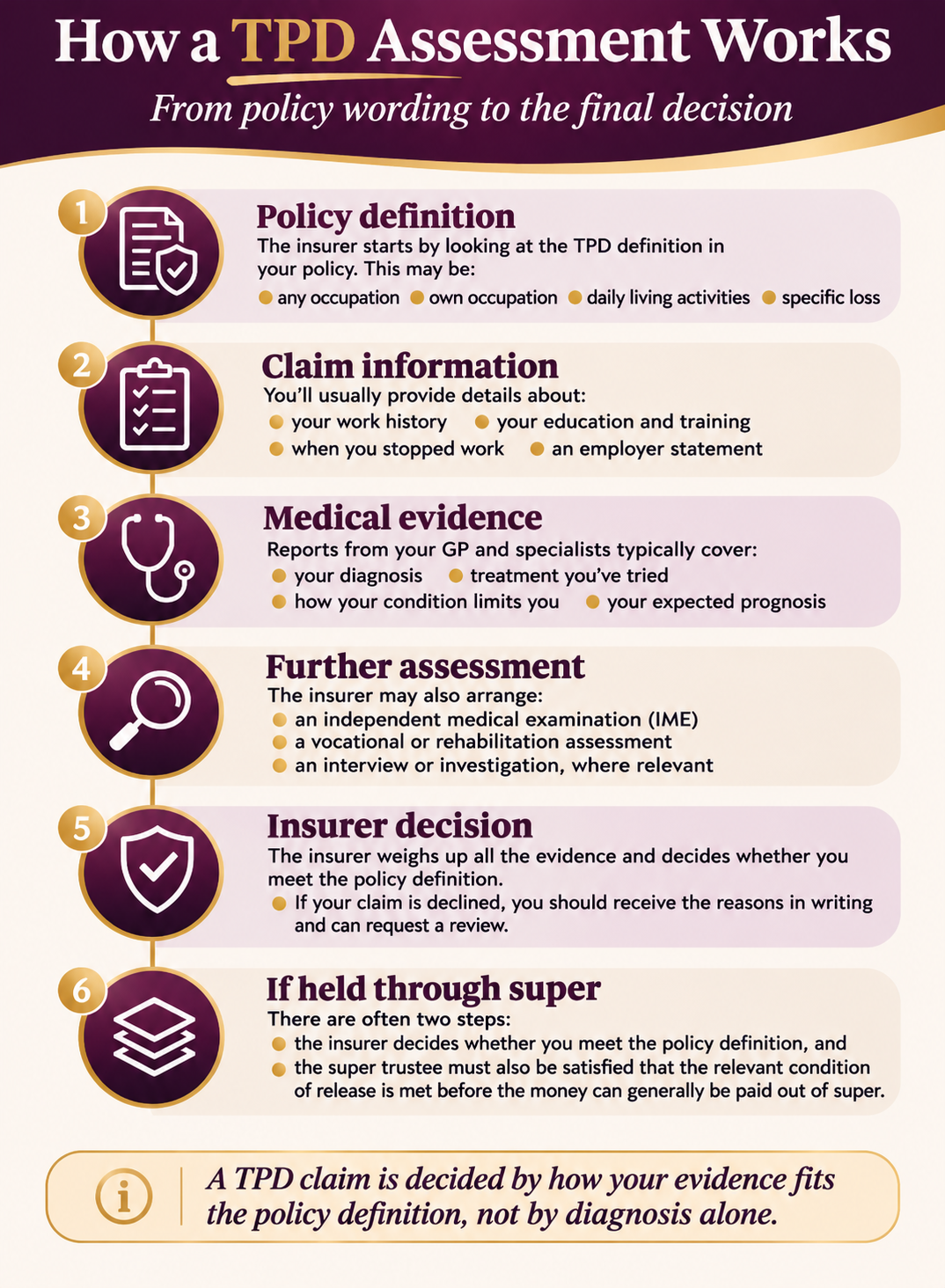
How a TPD assessment works, step by step
The process varies between insurers and funds. However, many claims follow a similar path.
Meeting the waiting period
Many policies require you to be off work for a continuous period, often several months, before the insurer will assess the claim. Some insurers will accept a claim earlier and start gathering evidence while the waiting period runs.
Claim forms and statements
You’ll usually complete a claimant statement covering your work history, education, symptoms and daily activities. Your employer may complete a statement about your role and when you stopped working. Your treating doctors will often be asked to complete attending doctor statements as well.
Medical evidence for your TPD assessment
Reports from your GP and specialists form the core of a TPD assessment. Insurers look for a clear diagnosis, the treatment you’ve tried, how your condition limits you, and, importantly, the expected prognosis. A report that addresses your long-term capacity to work is usually more useful than one that only lists symptoms.
Independent medical examinations
The insurer may ask you to see a doctor it appoints and pays for. Under the Life Insurance Code of Practice, you can ask for a list of doctors to choose from, including at least one doctor of each gender where practical. You can also request a copy of the examination report, which may be sent to you or to your doctor.
Vocational assessment for TPD claims
For “any occupation” claims, an insurer may commission a vocational or rehabilitation report as part of the TPD assessment. This looks at your skills, education and experience, and considers whether any realistic job remains open to you. Retraining may also be considered, particularly for younger claimants.
Interviews and surveillance
Some insurers interview claimants or use investigators, and the Code places limits on how they can do this. The Code also requires surveillance to stop where the insurer receives appropriate evidence that it is negatively affecting the claimant’s health, including mental health.
What insurers weigh up when deciding
The insurer then looks at the evidence as a whole. For example, it may consider:
- whether your treating doctors expect you to recover enough to return to work
- whether you’ve had reasonable treatment, and how you’ve responded
- your age, education, skills and work history
- whether any work you’ve done since your injury suggests remaining capacity
- the timing of when you stopped work and when your cover was in force
Insurers also have to act fairly and in good faith when they make a decision. If they rely on one report over another, they should be able to explain why.
“A TPD assessment is not a judgement on how unwell you are. It is a test of whether your evidence meets the wording of one particular policy.”
Two decisions for TPD claims inside super
When TPD cover is held through a super fund, there are often two separate decisions. The insurer assesses the insurance claim, while the super trustee must also be satisfied that the relevant condition of release is met before the money can generally be paid out of super.
These steps usually happen together. The trustee still has a separate role, which can affect when the money is released.
How long does a TPD assessment take?
TPD claims generally take longer to decide than other types of life insurance claims, because the insurer is assessing your long-term future rather than a single event. The Life Insurance Code of Practice sets timeframes for insurers to assess lump-sum claims such as TPD, although those timeframes can be extended where circumstances are beyond the insurer’s control.
Delays often come from missing or late information. Responding quickly to requests and giving your doctors enough time to complete forms can help the claim move along.
If your TPD claim is declined
The insurer should give you its reasons in writing, along with a summary of the information it relied on. You can ask for copies of that information. A declined claim can sometimes be reconsidered where new evidence addresses gaps in the original assessment.
You can generally make a complaint through the insurer or fund’s internal process first. If that doesn’t resolve it, you may be able to take the complaint to the Australian Financial Complaints Authority (AFCA), which is free. Time limits apply, so it’s worth getting advice early. A lawyer who specialises in TPD claims can also review the policy wording and the evidence.
Planning while your TPD assessment is underway
A TPD assessment can take months, and in that time your income may be limited. It’s worth thinking ahead about how a TPD payout could affect your tax, your super and your Centrelink position. Some decisions made soon after a TPD payment can be difficult to reverse.
Waiting on a TPD decision? Start planning now.
A conversation with HFI can help you understand how a TPD payout fits with your super, Centrelink and long-term income, before key decisions are locked in.
Call 1300 10 44 99 Read: Post-TPD AdviceImportant information
This article is general information only and does not take into account your personal circumstances. TPD definitions, claim requirements and assessment processes vary between insurers, super funds and policies, and outcomes depend on your policy wording and medical evidence. The Life Insurance Code of Practice, superannuation rules and Centrelink rules change over time. Check current requirements with your insurer, super fund or Services Australia before acting. HFI does not provide legal advice or tax agent services unless expressly stated. You should seek advice from qualified financial, legal and tax professionals before making any decisions about a TPD claim or payout.
Health & Finance Integrated is a Corporate Authorised Representative of Able Financial Services, ABN 27 646 319 164, AFSL 530596, Shop 6, 23 Hassall St, Parramatta 2150 NSW.